Mastering the Essay Format: A Complete Guide for University Students
Get Started Today
Fill out the form and get a quote instantly
Our Guarantees
- 100% plagiarism-free papers
- On-time delivery guarantee
- Free unlimited revisions
- Money-back guarantee
- 24/7 customer support
- Complete confidentiality
Why Wait?
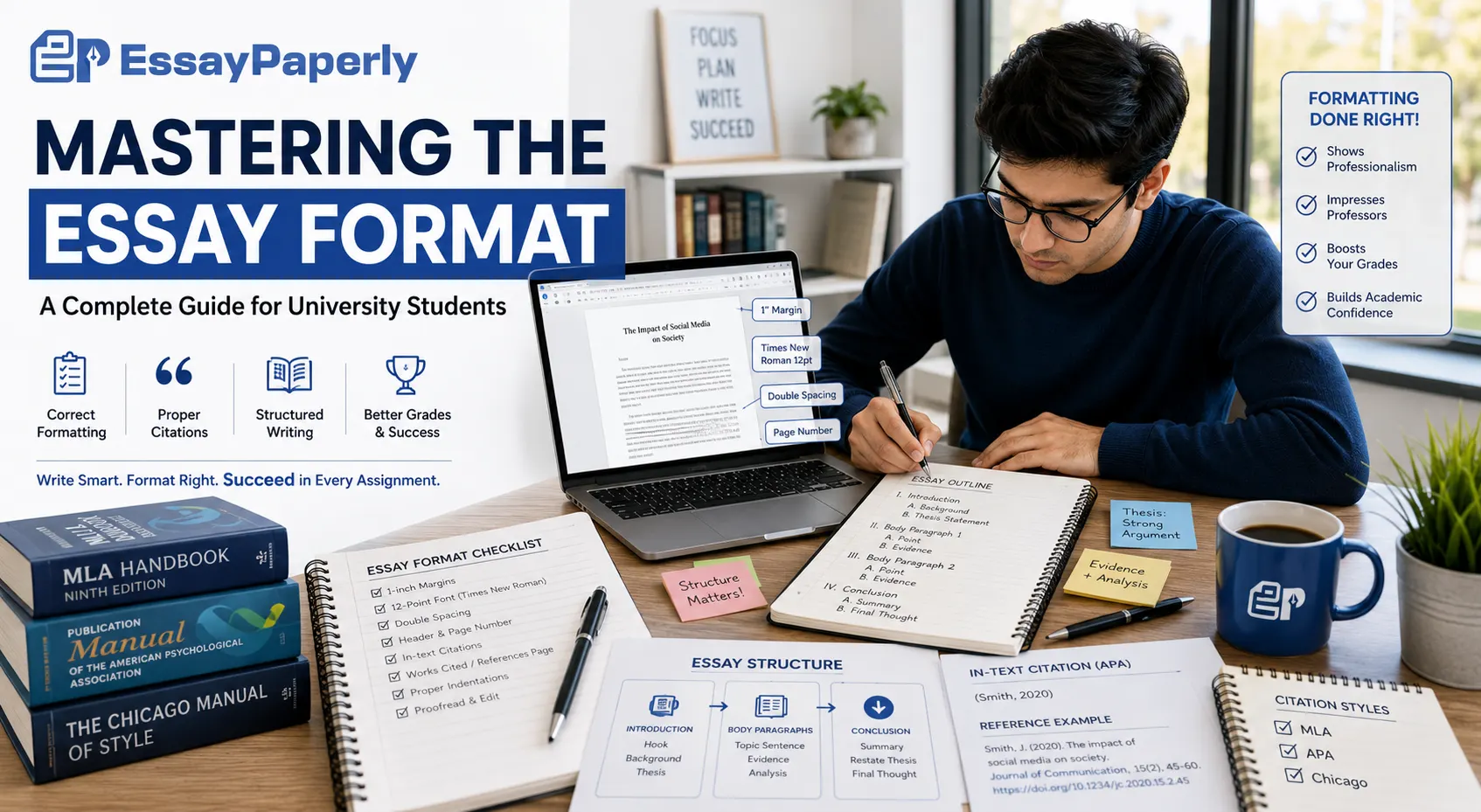
You have an essay due soon and you know what you want to say. But when you sit down to write, everything falls apart. The margins look wrong. The citations refuse to behave. And you cannot remember where the page numbers go.
This happens to more students than you think.
Here is the truth. The structural essay format matters more than most professors admit. A properly formatted essay tells your reader you care about the details. It shows respect for the assignment. And it can push a B+ paper into A+ territory just because everything looks clean and professional.
Let us walk through what you actually need to know. No confusing rules. No academic jargon. Just practical help from someone who has been exactly where you are.
Why Essay Format Matters for Your Grades
Formatting used to feel like a waste of time. Write the content and hit submit. Who cares about margins? Then the paper came back with comments like "incorrect header" and "check your margins." Points disappeared for reasons that had nothing to do with my ideas. That was a hard lesson.
Adhering to a standardised essay format is not just about random rules. Professors use formatting as a quick filter. A paper that follows the correct format looks credible at first glance. A paper that ignores format looks careless, even if the content is brilliant.
Most rubrics quietly give 5 to 10 percent of your score to formatting and citations. A 90 percent paper can drop to 81 percent simply because your core essay format was wrong. Do not let that happen over something so easy to fix. If you ever feel completely overwhelmed by these technicalities, you might find yourself looking up a professional essay writing service just to see how the experts handle the layout. However, learning it yourself is entirely possible.
Common College Essay Formats You Will See
Different assignments ask for different styles. The specific college essay format you use depends on your subject and your professor's preferences. For instance, the MLA format essay dominates English, literature and humanities courses. It uses 12-point Times New Roman, double spacing and a specific header system. Additionally, the MLA essay format requires your last name and page number in the top right corner of every page.
Conversely, the APA essay format rules psychology, education, nursing and social sciences. Setting up an APA format for essay work needs a title page, sometimes an abstract and a distinct way of handling citations. The standard APA format essay also needs a references page at the end.
The Chicago format essay appears in history and some advanced humanities courses. While this format of essay is less common, it is certainly worth knowing.
Finally, some professors just ask for a generic formal essay format that is not strictly bound to MLA or APA. Always check the assignment sheet first to determine the exact essay format for college courses you are expected to follow.
Here is a quick comparison table to help you see the difference between MLA and APA essay format:
|
Features |
MLA Format Essay |
APA Format Essay |
Chicago Format Essay |
|
Title Page |
Not required |
Required |
Optional |
|
Header |
Last name + page number |
Page number only |
Page number only |
|
Citations |
Author + page number |
Author + year |
Footnotes |
|
References Page |
Works Cited |
References |
Bibliography |
Mastering the MLA Format Essay
Let us start with the MLA format essay because it is the most common style for first-year writing. The MLA essay format follows a predictable pattern. Learn it once and you can use it for almost any humanities paper.
Here is what you need for a proper MLA format essay:
- Margins: One inch on all sides. Word and Docs set this as the default.
- Font: 12-point Times New Roman. This is the safest choice for this style.
- Spacing: Double-space everything – the heading, title, body, and works cited page. No extra spaces between paragraphs.
- Header: Last name and page number in the top right of every page using the automatic page number function.
- Heading on first page: Left-aligned. Type your name, professor's name, course and date on separate lines.
- Title: Centred below the heading. Do not bold, underline, or italicise it.
- Works Cited page: Start on a new page. Centre "Works Cited" at the top and list sources alphabetically with a hanging indent.
Here is a visual MLA format essay example to picture. Your first page shows your heading on the top left. Then your title is centred. Then your first paragraph is indented half an inch. The top right shows your last name and page number. It is not so scary once you see the pattern.
Understanding the APA Format Essay
The APA format essay looks quite different from an MLA paper. If you take psychology, nursing, education, or business courses, you will consistently use the APA format for essay submissions.
Here is what changes:
- Title page required: Your APA essay format must start with a dedicated title page featuring your title (centred and bolded), name, university, course, instructor and date.
- No heading on body pages: Unlike MLA, APA student papers only require the page number in the top right.
- Abstract for longer papers: If your paper exceeds 1000 words, you may need a 150-250 word summary on its own page.
- In-text citations: APA uses author-date format, like (Smith, 2020). Page numbers are only for direct quotes.
- References page: Titled "References" instead of "Works Cited," listing the author's name, initials, year, title and source.
Many students find managing an APA format essay harder than the MLA alternative because there are more moving pieces to assemble. Double-check everything before you submit.
Other Essay Formats You Should Know
Not every assignment fits neatly into MLA or APA. Depending on the genre of your writing, you will run into several other layout styles:
- A persuasive essay format needs a clear thesis in the introduction, body paragraphs with one supporting point each and a conclusion that reinforces your argument.
- The narrative essay format tells a story from your life. Because the narrative essay format is more flexible, formal citations are rarely required.
- An informational essay format (also widely referred to as an informative essay format) explains a topic objectively without taking a side. Use clear subheadings and strong topic sentences.
- A short essay format condenses everything into 500 words or fewer. Each section becomes much shorter. Use one strong example instead of three.
- A personal essay format blends storytelling with reflection. It uses "I" freely and does not need formal citations.
- The scholarship essay format follows the application prompt directly. Answer the question and show your unique qualities while following the word limit strictly.
- The college application essay format should be personal, specific and honest. Admissions officers can spot disingenuous writing instantly.
Using an Essay Format Template
Utilising an essay format template can save you an immense amount of time. Most word processors offer built-in templates specifically configured for MLA and APA layouts.
Here is how to use one:
- Search for "MLA" or "APA" in your software's template gallery.
- Select the essay format template that matches your assignment.
- Save it as a new document before typing anything.
- Replace the placeholder text with your own content.
- Double-check that the template matches your professor's preferences.
Even with a good technical layout, verify every rule manually. Templates are helpful, but they are not always perfect.
Common Essay Format Mistakes to Avoid
These essay format or layout errors appear again and again. Avoid them and you will be ahead of most students.
- Wrong font or font size: Use 12-point Times New Roman unless explicitly told otherwise.
- Incorrect spacing: Double spacing means no extra spaces between paragraphs.
- Missing or wrong header: MLA wants your last name and page number. APA wants just the page number. Securing a proper essay format means knowing the difference.
- No title page when required: APA needs a title page. Check the assignment sheet.
- Wrong citation order: MLA and APA both list sources alphabetically, not in the order they appear.
- Forgetting the hanging indent: The first line is flush left, and every subsequent line is indented half an inch. Maintaining a clean essay paper format relies heavily on getting these visual details right.
The Essay Writing Format from Start to Finish
Executing a correct essay writing format covers more than just margins and fonts. It is about a disciplined workflow. Here is a process that works:
- Step 1: Read the prompt three times. Underline keywords and circle formatting requirements.
- Step 2: Set up your document and apply the correct essay format right away.
- Step 3: Write a rough outline listing your main points in order.
- Step 4: Draft the body paragraphs first. Write the introduction later.
- Step 5: Add citations as you write. Do not wait until the end.
- Step 6: Write the conclusion. Summarise your argument with no new ideas.
- Step 7: Write the introduction last so you know exactly what your essay says.
- Step 8: Format the works cited or references page.
- Step 9: Print and read aloud to catch hidden errors.
- Step 10: Submit your work.
Getting Proper Essay Format Right Every Time
Achieving a proper essay format is not about memorising every single rule. To make things easier, keep an essay formatting checklist near your computer that covers margins, fonts, spacing, headers, titles, page numbers, citations and reference pages. Ensuring your essay format reflects these guidelines before every submission will quickly make college formatting second nature.
While your first MLA paper will take some extra effort, your tenth will require almost no thought at all. Every student struggles with formatting at first, but it becomes muscle memory over time. Even graduate students double-check before submitting their work.
Conclusion
You now have a complete guide to mastering the essay format for any college assignment. The rules are clear and the steps are simple. Take one assignment you are working on right now and check its formatting against what we have covered. Fix one thing, then fix another.
If you want to see exactly how these rules look on a perfectly polished final draft, you can always review the academic formatting benchmarks over at Essay Paperly. Small corrections add up to a professional final product. What formatting mistake has cost you points in the past? Identify it, check a reliable reference and make a plan to never let it happen again.